Oil on canvas: how a painting is built
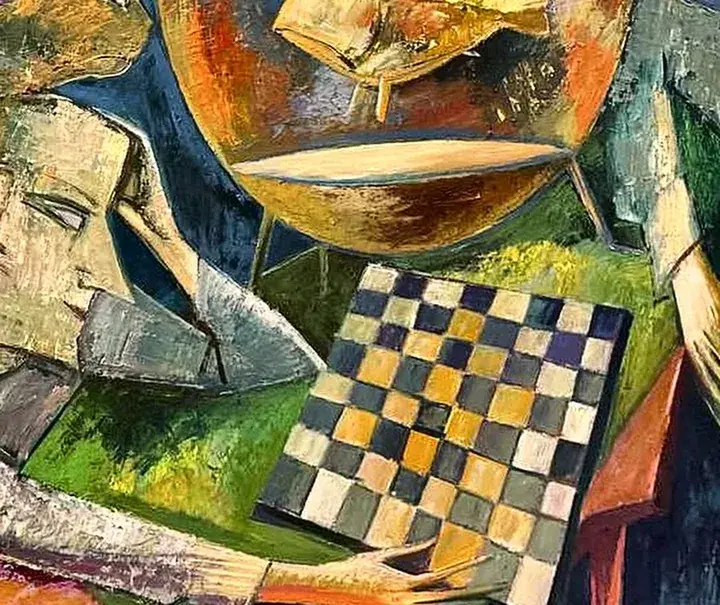
Table of contents
Looking at a finished painting, it seems the paint simply sits on the canvas. In fact oil painting is a layered construction in which every level has its function, and between them slow chemical processes continue for decades after the artist has put down the brush.
Understanding this is useful beyond curiosity. Knowing how a painting is built helps you judge it properly, store it correctly, and tell it apart from an imitation.
The support: canvas and stretcher
Everything starts with the fabric. The classic support is linen: strong, stable, and barely stretching over time. Cotton is cheaper but reacts more to humidity — it sags and tightens again as conditions swing, and paint dislikes that.
The canvas is stretched over a wooden stretcher. A good stretcher has keys in the corners: if the fabric slackens after years, the tension can be adjusted without restretching.
The format is not arbitrary either. Standard stretcher sizes settled historically, and a work in a non-standard format means the artist built the stretcher for a particular idea.
The ground
Raw canvas is unsuitable for painting: oil would soak into the fabric, make it brittle, and destroy it within decades. So the canvas is primed.
The ground does three things: it isolates the fabric from the oil, gives the paint something to grip, and sets the tone the work begins from. A white ground returns light through semi-transparent layers; a coloured one mutes it and binds the palette together.
The underpainting
The first layer of painting rarely resembles the finished picture. The underpainting lays out the masses: where the light falls, where the shadow sits, where the composition leads. It is painted with thinned colour, quickly and without detail.
The point is to make mistakes cheaply at this stage. Correcting a composition in the underpainting is an hour's work. Correcting it once five layers are down is effectively impossible.
The layers
Now comes the reason oil is used at all. Unlike watercolour or tempera, oil paint dries slowly — from several days to weeks depending on pigment and thickness. This allows long work and gradual building.
Glazing — a thin semi-transparent layer over a dried one. Light passes through, reflects off the layer below, and returns to the eye already coloured. This is how the depth of colour arises that cannot be had in a single pass.
Impasto — thick paint laid on with body. It holds its form, catches raking light, and gives physical surface: the painting stops being a plane and acquires relief.
Most works combine both: transparent shadows, dense lights. An old scheme that has worked since the fifteenth century.
Drying time
Oil does not dry by evaporation, as acrylic does, but by oxidation: the oil takes up oxygen and polymerises. The process is uneven.
The surface becomes dry to the touch within days. But full curing of a layer takes months, and of a large impasto work up to a year. That is precisely why a fresh painting is not varnished immediately: a layer sealed under varnish gets no oxygen and never hardens properly.
This is not a defect or a sign of unfinished work. It is the normal state of a fresh painting, and a buyer should know about it.
Varnish
Varnish serves two purposes. Protective: it takes on the dust, soot and minor damage, and can be removed and reapplied without touching the painting. Optical: it evens out the sheen and restores to the colours the saturation they lose in drying.
It is applied no sooner than six months after completion, more often after a year. Conservators renew varnish every few decades — which is why seventeenth-century paintings look fresh.
Why it lasts for centuries
Oil painting is the most durable of painting techniques, and that is not rhetoric.
Polymerised oil forms a strong, elastic film that does not crumble or flake. Mineral pigments are chemically stable. Varnish can be removed and replaced. Under normal storage conditions a painting has no built-in expiry.
By comparison, a printed reproduction is a layer of ink on paper or imitation canvas. It fades, yellows and delaminates within decades. The difference is not aesthetic but material.
Telling an original from a reproduction
Several signs are visible to the naked eye.
Relief. Look at the work at an angle, in raking light. An original has surface: brushstrokes stand proud, there are hollows and thickenings. A print is flat, even when an imitation gel has been applied over it.
The canvas edge. On an original, paint runs unevenly over the side, with accidental drips. On a print the edge is clean or the image stops abruptly.
The reverse. An original shows where paint has pushed through the weave, the ground is visible, and there are no traces of machine stretching.
Signature. A signature painted in oil has the same surface as the painting. A printed one lies in the plane of the image.
Frequently asked questions
Can a fresh painting hang without varnish?
Yes. An unvarnished work is entirely fit to display, merely a little more vulnerable to dust. The important thing is not to wash it or wipe it with anything damp.
Does oil darken over time?
The oil film yellows slightly; this is a normal process. It shows more on cool-toned paintings than warm ones. Renewing the varnish restores the original appearance to a large extent.
Why does one painting cost more than another of the same size?
The number of layers and the hours of work differ by a wide margin. A multi-layered work with glazes takes months, with pauses for drying; an alla prima study takes a single session. Size is only one of the parameters.
Can a damaged painting be restored?
Yes — oil painting responds to conservation better than any other technique. Tears in the canvas are lined, losses in the paint layer are retouched, darkened varnish is removed. This is work for specialists.
If you would like to see the surface for yourself, come to the studio in Warsaw by arrangement. Photographs convey relief poorly, while the difference from a print is obvious at once.